|
Home page | Flights to Crete | Car rental in Crete | Holiday apartments | Info Crete | Road maps | Distances in Crete | Contact us |
|
|
|---|
|
|
<<<<<<<<< >>>>>>>> |
|
|
Ziros is a small village, part of the Municipality of Sitia since 2010, located at the extreme south-east of the island of Crete, on the eastern edge of the Armeno-Handratico plateau, lying at 590 meters of altitude on the slopes of the hill Engremnò. |
|
|
Its existence has ancient roots but the historical reports concerning it go back only to the first census carried out by the Venetian rulers around the year 1570. |
|
Census that attributed about 500 inhabitants.
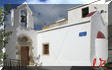
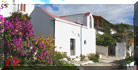
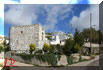
Today Ziros has not in fact grown numerically and was significantly affected and suffered the phenomenon, common in Europe to many mountain communities, of progressive depopulation and slow abandonment of the rural settlements. The village, however, probably "thanks to this aging" of its population, retains an almost intact ancient charm. Its narrow streets, winding and climbing on the hill, its rustic stone houses, are the perfect image of a traditional Greek village. These are places where time seems to follow other rhythms. |
 |
 |
|
Places that deserve to be visited and photographed and we hope that in future they can be restored respecting their original simple architecture. |
|
|
In this sense a different evaluation deserve all the Orthodox Churches |
|
of Ziros, from the larger Agios Georgios to the smaller Agia Paraskevì, |
 |
|
Agios Nikolaus and Agia Irini (quoting here only those that fall within the historic center), which are all in good condition, |
|
all preserved with great care in the very smallest detail, (a clear and obvious demonstration of the strong |
|
attachment of this people to its religion) and characterize the most beautiful areas of the village. |
|
In Ziros the economic activities are related to agriculture and sheep-rearing. |
 |
The main cultivation of the plateau are the wineyards and here is produced a fine quality of sultana grape destinated both to the wine production and to the distillation of the traditional cretan rakì (a dry liquor, very similar to the Italian grappa and close to 40°) |
|
and if you pass in this area during the month of October it will not be difficult for you to be invited to attend some celebration that takes place around the "Kazani, the traditional copper stills where boil the musts and where the year agricultural work comes to an end.
The sheep-rearing instead is practiced on all the mountains that surround Ziros; it is pretty common here to meet flocks grazing next to the roads that depart from the village and here you can still attend the traditional flock move to and from the mountain pastures in the months of December and April.
The production of meat and cheese is still a pride for this region and is treated carefully following ancient traditions. |
|
|
|
In the village, on the main street, you will also find other activities and other commercial services, namely : |
|
|
two mini-markets, a butcher, a bakery, a pub, a ATM, the post office (housed in a Kafenio!), a restaurant, a small pension, a carpentry and then, inevitably, others Kafenii (traditional bars where in the evening virtually meet all inhabitants, among Greek coffee, rakì, mezè, games of cards and chats of all kinds).
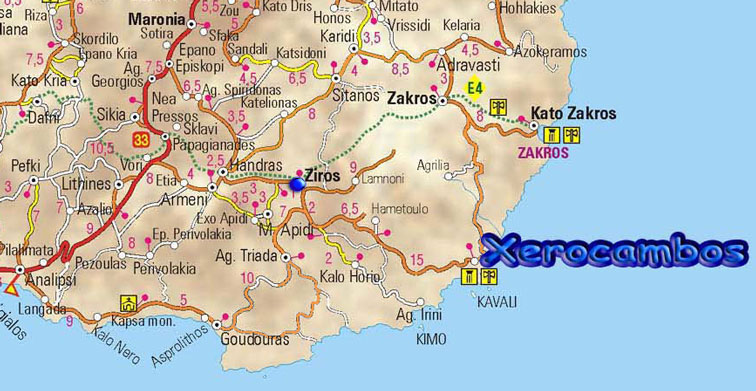
Ziros can be reached in about 25 minutes drive from Xerocampos taking the road, full of bends and long 18 kilometers, that climbing up the mountain on the south reaches first Hametoulo (here you will find the crossroad for the track that leads to Agia Irini); continuing you will meet on the right on the highest point, the entrance road to the military radar installations and then going down, almost reaching the valley, on the left first the crossroads for Kalò Horiò and then for Agia Triada, Aterinolaco and Gouduras, finally just before the village you will find another crossroads on the right that leads to Lamnoni and to the most panoramic area called "Mare". |
|
|
<<<<<<<<<< >>>>>>>>>> |
|
 |
|
|
<<<<<<<<<< >>>>>>>>>> |
|
|
|
|
|
|
Car rental in Crete | Holiday apartments in Xerocampos | Information |
|
©Web-Master Andrea Marini andrea18@otenet.gr - marinator2001@yahoo.com
Registered in the Register of the Touristic Companies of The Tourist Greek Organisation (EOT) since 25.09.2013 with authorization number 1040E 6061 01822 01 |
|
|
|
|
|